
Human Capacity
Future organizations should be designed to unlock the full multidimensional human capacity.

As part of the next iteration of Fluency in Care, we’re expanding concepts that we think need new interpretations, ones that carefully align with our proposal. One of the notions that is essential to be able to express and elaborate a deeper understanding of care as a collective commitment towards more livable futures is the meaning of Human Capacity.
In the following images, you’ll find how we’re beginning to describe, and map, Human Capacity across multiple dimensions. We’d love to hear your thoughts and reflections. We’ve also created a shared document (link) where you can read a more detailed text version and, if you prefer, add suggestions directly in context.
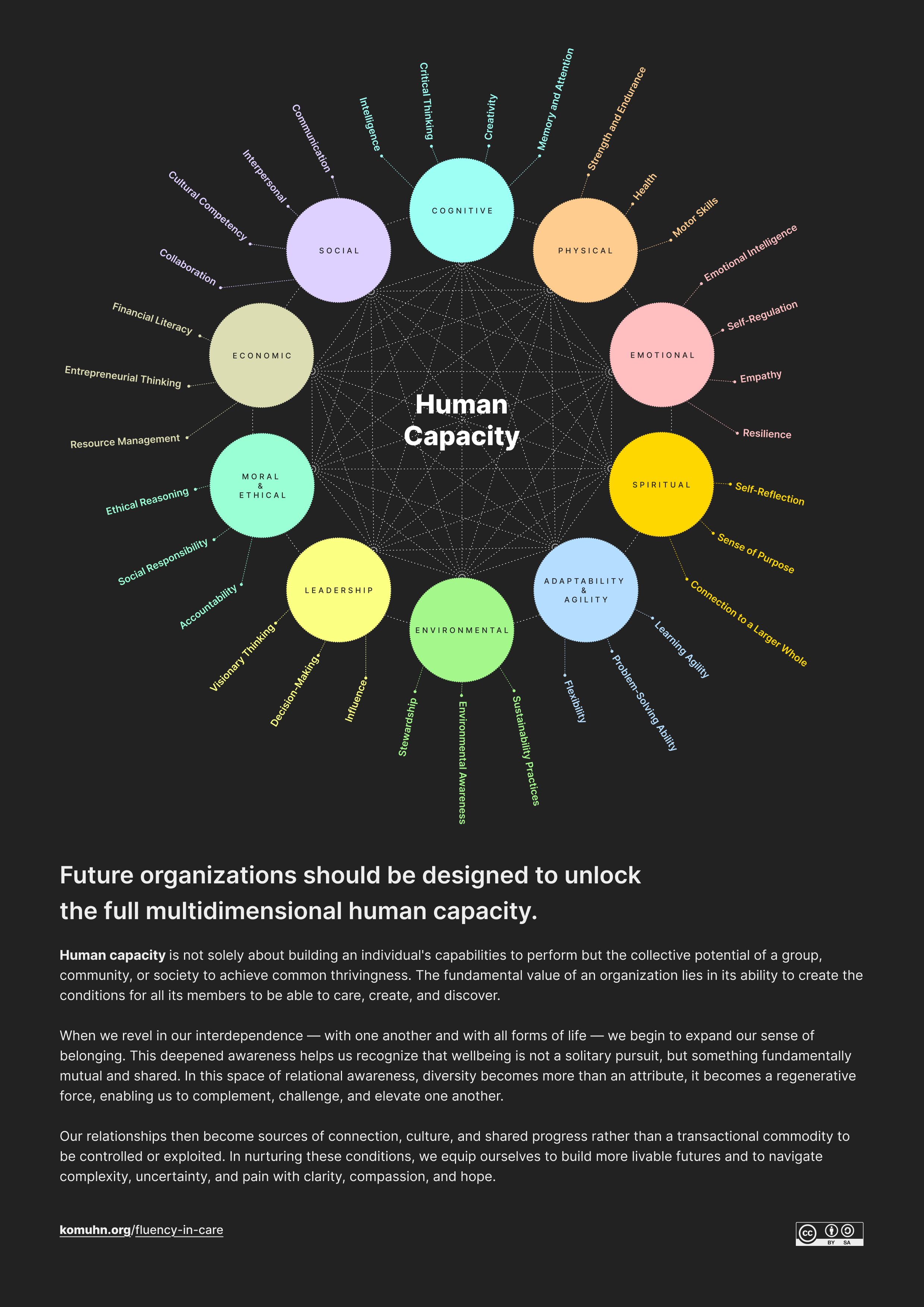
With this work, we’re looking to align the perceptions implied in the words we’re using and to evolve the language that’s emerging from our new realizations. Here are some examples of what’s guiding our thinking:
- The point of view is collective: We’re conditioned to interpret human capacity as individual ability. But we’re exploring how capacities emerge and amplify at the group level. For example, creativity isn’t just a trait of a singular mind, it’s something a group can cultivate, distribute, and expand.
- The term as an enabler of perspective: Choosing to use the word capacity instead of using ‘time’ or ‘money’ can unfold new conversations. By considering the superset, we acknowledge that there’s more implicit meaning, and that we need to assess all its parts. For instance, when someone states that there’s “no time” left to do something, we can instead talk about the reasons for that perceived shortage and bring in other capacities that can make up for it.
- Systemic awareness: By expanding the concept of human capacity into a set of shared capabilities, we start seeing how they connect and affect each other. This allows us to identify where the group is sensing imbalances, and propose ways to allow the oddity, embracing the value of the group’s uniqueness, or finding ways to restore balance.
- Inspire new shared practices: Through this exploration, we’re uncovering new ways to benefit from a common language. From designing new group routines to challenging social patterns, we’re curiously looking for better ways to relate, organize and create together. One manifested usability is capacity matching, to measure the potential opportunities within a group: for example, if we signal that we have capacity:financial-literacy and capacity:environmental-awareness, what might that allow us to do? Do you have more ideas? Share them with us!
We’re currently being very critical of the language we use and the associations we make, and we’re especially interested in input towards changing terminology, adding or removing elements, and questioning our categorizations and relationships. We’d also love to hear about any work you know of that explores similar directions.
Looking forward to your contributions 🙌